Showing posts with label Vegetarian Recipes. Show all posts

Saturday, 28 November 2015

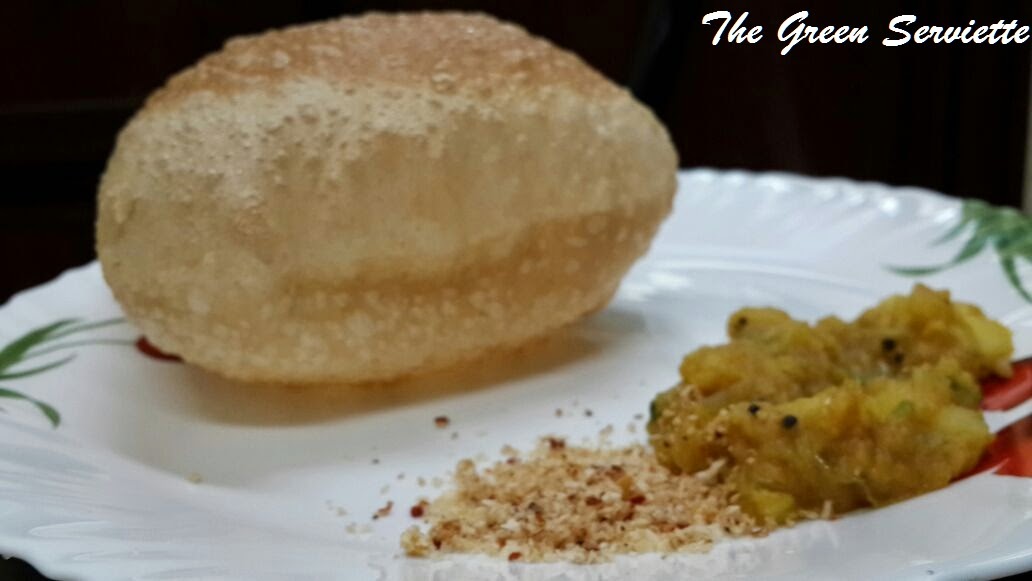
Garma garam Poori/Puri


And there are times, however healthy you try to eat, you want a heavy greasy breakfast. It may feel absolutely sinful but a couple kilometers run will help you get over that feeling. Poori accompanied with any curry of your choice. Bhaji, kala chana, chole vegetable korma or even halwa; best weekend breakfast. Easy, simple and straightforward.

This recipe serves 2 people and makes 6 pooris. Each puri gives approximately 107 calories.

Here is what you’ll need:


1 cup whole wheat flour
1 tsp oil
½ tsp salt
Water as required
Oil for deep frying

Method:

  1. Sieve the flour and add salt and oil to it.
  2. Mix together and slowly start adding lukewarm water forming stiff dough.
  3. Knead well for 5 minutes and rest the dough covered for 20 minutes.
  4. Make small portions out of the dough and roll it out into 4 inch diameter.
  5. Heat the oil and test with a small portion of dough if the oil is well heated.
  6. The dough should bubble and rise, Once the oil is heated, fry each puri at a time.
  7. Slowly lower the rolled out puri into the oil and immediately splashing oil on top and pressing gently with the back of a spoon.
  8. Once the poori puffs up, turn the other side.
  9. Once it turns golden brown both ways, remove it out on a kitchen towel to absorb excess oil.
  10. Serve hot or keep it in a casserole.


NOTE:

  • While kneading, make sure the dough is stiff unlike regular chapatti.
  • While rolling do not use more flour to dust it. A good dough does need flour for dusting. If required use little oil to help roll.
  • Fry, only when the oil is well heated. The heat should be medium high.

 Also try Potato Masala in The Kitchen Counter column.

Recipe by Zohra Sada

Tuesday, 10 November 2015

Puttu - Rice powder and coconut delicacy

Making of the puttu podi:


Puttu: Steamed cylinders of finely powdered rice and coconut layers. A favorite breakfast in the Kerala cuisine. Most of the recipes for puttu ask for buying ready made rice flour or puttu podi meant for making puttu. I have often heard friends complaining that puttu made of ready puttu podi turns out very stiff and hard. We like our puttu crumbly and soft. So here is the puttu recipe from scratch.

I have used a mixture of brown or Kerala Parboiled rice along with just normal parboiled rice. The brown parboiled rice tends to make the puttu even softer. Wash and soak the rice for 3 hours atleast. Once soaked, drain the rice and spread it out on a cotton cloth to dry the rice for 10 - 15 minutes.


Dried rice is easier to grind and does not clump together.  Once dried, use a heavy duty grinder to finely powder the rice. Remember, the powder should be extremely smooth. It may take 5 minutes of grinder time. Do not powder all the rice at once. Make it into 2-3 batches. Your rice powder for the puttu is ready. This puttu powder can be done in bulk and stored in freezer for a couple of months.

Once ready to assemble the puttu, take rice powder in a deep dish, add a tsp of salt and 2-3 tsp of sugar. Add 2 tbsp of water and mix well. The water is added bare minimum to help the puttu cook with steam. If the mixture becomes wet or if the coconut filling is moist and you are using a puttu maker, you are inviting disaster. The pressure builds up and the whole cylinder of puttu will jump out with a blast. Literally. Been there done that. Be careful.


The layering of puttu can be done with plain coconut or spicy coconut masala with shredded chicken. Check out the recipe of Coconut Masala. Plain shredded coconut can also be used as a topping and a side dish of chicken/ sambhar can be served.

For assembling in a puttu maker, start at the bottom with a layer of plain shredded coconut. The second layer will be the rice powder. The third layer will be either the coconut masala or plain coconut. This will go on repeating till the last layer will be a coconut/masala layer. You can now steam your puttu. The doneness of your puttu is when your puttu maker steams.

If you want to make puttus and you don’t have a puttu maker, use your steamer and idli vaatis/bowl. Each individual bowl will be a puttu. The base layer will coconut filling and top it with rice powder. Pop these into your steamer and steam for 5 minutes.

If you like your puttus sweet make plain puttus with plain coconut topping and whilst serving add a tsp of ghee and sugar.

This recipe will serve 4 people. Each serving (3 puttus) of puttus give 414 calories approximately.

Here is what you’ll need:


¾ cup Kerala parboiled rice
¼ cup parboiled rice
1 tsp salt
2 tsp sugar
2 tbsp water

Method:

  1. Wash and soak the rice for 3 hours
  2. Drain the rice and spread it out on a cloth and dry for 10- 15minutes
  3. Grind the rice into a fine powder
  4. Add salt sugar and water
  5. Assemble the coconut filling and rice powder in a puttu maker and steam
Recipe by Zohra Sada

Sunday, 1 November 2015

Sweet Momos / Hatha Welli Nawari


Only for ease of understanding I have named them as sweet momos. Though the recipe is very similar to that of momos, this is a traditional bhatkali recipe going by the name of “hatha welli nawari”. 

The method of preparation is similar to that of momos. But here the filling is sweet with a coconut base. I have used jaggery as a sweetener. Sugar works extremely well too.


The skin for the momo is made of semi cooked dough. Once the water comes to a rolling boil, switch off the flame.  Add the salt and ghee and dump in all the dough at once and then go ahead and knead to medium soft dough.  Once the dough is ready, pick out small pieces and roll out into chapathi.


On one half side of the chapathi spread a thin layer of the filling .Now fold the chapathi and seal the edges.


The momos are ready to get steamed.

This recipe makes around 20 momos.
Each serving (1 momo) gives approximately 92 calories.

Here is what you’ll need:

For the filling:

1 cup fresh coconut
1- 1 ½  cups jaggery/sugar
1 tbsp rose water
¼ cup almonds and cashew nut chopped
1 tsp sesame seeds (til)

For the dough:

1 cup water
1 ¼ cup all purpose flour (maida)
1 tsp ghee
½ tsp salt

Method:

  1. For the filling mix the coconut, jaggery and nuts in a heavy bottom pan and let it cook on low flame till the coconut cooks, jaggery melts and the mixture steams. Add a tbsp of rose water.
  2. For the dough, in a large pot bring the water to a boil.
  3. Add salt and ghee to the water.
  4. Once the water comes to a rolling boil, dump in all the flour at once and start mixing it with a wooden spatula.
  5. Once the dough starts clumping together, lay it out on a flat surface and knead it well till it forms soft dough.
  6. Pick out tiny lemon sized balls of dough, knead each of them and roll out skin thin chapathi.
  7. Add the prepared filling to one half and seal shut by pressing the edges together.
  8. Keep the prepared momos on a  paper.
  9. Bring the steamer to a boil. Grease the steamer plate with few drops of oil to avoid the  momos sticking.
  10. Once the water boils, arrange the momos on the steamer plate. Take care that each piece don’t touch the other.
  11. Steam for 10-12 mins.
  12. Serve cool. 


Recipe by Zohra Sada

Friday, 16 October 2015

Pav Bhaji


A popular Indian fast food originated in the Maharashtrian cuisine, the pav bhaji is the most widely sold food on Mumbai’s street. Everybody’s favorite lunch, snack or dinner, the word bhaji means vegetables and pav means bread roll. The pav bhaji is a spicy tangy mixture of vegetables largely of potatoes, generous amount of tomatoes, topped with butter. It’s served hot with warm soft rolls of bread or pav toasted in butter.


The recipe for pav bhaji may vary largely but the basic ingredients and general method of cooking remain the same. Potato is the base vegetable and to that cauliflower, carrots, peas or even beets can be added. Sometimes cooked and mashed toor or masoor dal is also added to maintain consistency. Capsicum is another essential ingredient that is added which gives a distinct flavour.

This recipe serves 4 people providing approximately 200 calorie per serving of the bhaji.

Here is what you’ll need:

2 large potatoes
1 cup of vegetable (carrot/cauliflower/peas)
2 tbsp butter
¼ cup capsicum
2 large tomatoes
1tbsp tomato paste (optional)
1 tbsp ginger garlic paste
3-4 green chillies chopped
 6 pav for serving with the bhaji

Garnish:
1 onion finely chopped
2 tbsp coriander
Butter
Lime wedge

Pav bhaji masala powder:
¼ tsp turmeric
1 tsp red chilli powder
1 tsp coriander powder
1 tsp cumin powder
½ tsp garam masala
1 tsp chat masala

Method:

  1. In a pressure cooker, cook the potatoes and optional vegetables till soft.
  2. In a flat bottom pan, melt the butter. Add the ginger garlic paste and chillies till the raw smell goes.
  3. Chop the tomatoes finely and fry it in the butter till the tomatoes soften and became mushy. Add salt to hasten the process.
  4. Add finely chopped capsicum to the tomatoes and sauté for a few more minutes.
  5. To this sprinkle all the masala powders, be careful not to burn.
  6.  Immediately add all the cooked vegetables and required amount of water.
  7. Mash the vegetables till they lose their shape and form a thick gravy like paste.
  8. Cook further till the bhaji reduces to the desired consistency.
  9. Garnish with chopped onions, coriander, fresh butter and a wedge of lime.
  10. Serve hot with warmed pav.
Recipe by Zohra Sada

Wednesday, 7 October 2015

Groundnut Jaggery Chikki


Chikki or peanut brittle is a power packed nut bar made with jaggery and peanuts. There are several different varieties of chikki in addition to the most common groundnut chikki. Each chikki is named depending upon the ingredients used. Chikki can also be made with sugar. It’s a healthy snack option and a powerhouse of iron and omega fats. Apart from making the chikki bar, chikki ladoos can also be made with this same recipe.

Ingredients:

500 gm skinless peanuts/groundnuts (Split)
300 gm jaggery, cut into small pieces
4 tbsps ghee/ clarified butter 

Method:

  1. Heat a pan on a medium flame, and gently roast (stirring frequently) the peanuts. Remove from heat and cool.
  2.  Grease a large, flat plate with some ghee and keep aside.
  3. Put a deep, heavy-bottomed pan on the fire (medium heat) and add the jaggery and ghee to it. Allow to melt and cook (stirring almost continuously) till it turns dark brown. Test for doneness now and often till ready. You will know it is ready when a drop of it put onto a clean surface, cools to harden to a brittle consistency.
  4. Turn off the heat and add the roasted peanuts. Fold in so the peanuts are fully coated. Immediately pour this mixture onto the previously greased plate and smooth with the back of the spoon to form a flat, 1/2" thick layer. Allow to cool then break into bite-sized pieces.
  5. To make chikki ladoos, wait till the mixture is warm enough to take in hand and shape into small balls.
  6. Chikki can be stored for a couple of days in an airtight container, in a cool, dry place.

Note: Sometimes the chikki may turn out to be extra sticky and hard on the teeth, to avoid this you can add a little amount of water while melting the jaggery.

Recipe Faiz Lahori

Monday, 28 September 2015

Aloo Paratha - The two authentic methods!


OK! Have it your way. If you have already checked the Easy Aloo Paratha recipe and you still want to do it the “authentic” way. Here you go.

Prepare the potatoes first. If you like to keep it simple, good with me. Just add salt, red chilli powder, cumin powder and some chat powder. If not, let’s spice it up some more.

The first method of making the aloo paratha is where you divide one portion of the dough into two. Roll each of them separately into 4-5” diameter. Spread generous amount of aloo mixture on one side and cover it with the other. Pinch down the sides firmly till completely sealed. Now start rolling, by initially gently patting down with the hand. Then go ahead and use a rolling pin to roll out the parathas larger. 


The second method of rolling the paratha is taking a single portion from the dough and flattening it with your hand. Roll it out to about 5” diameter. Place the aloo mixture the size of the dough into the flattened dough. Pick up the edge and start pleating the dough brining all the edges to the centre. Tug the edges gently and keep flattening the edges if required. Once the dough is completely sealed sprinkle some dry flour and start rolling the paratha by gently pressing with your fingers. Once it flattens to a 5 inch diameter again then use the rolling pin to flatten it out completely. 


This recipe makes 6 parathas and one paratha provides approximately 205 Calories.

Here is what you’ll need :


2  medium potatoes
1 onion finely chopped
1 tbsp oil
5-6 curry leaves
1 tsp ginger garlic paste
3 chillies finely chopped            
½  tsp coriander powder
½  tsp cumin powder
1 tsp chaat masala
½ tsp red chilli powder
Salt
 1 tbsp oil
2 cups Whole wheat flour
½ tsp sugar
Butter/oil/ghee to fry

Method:

  1. Pressure cook the potatoes till soft and grate them.
  2. In a kadai, heat 1 tbsp oil and fry the ginger galic, curry leaves and chopped green chilli.
  3. Add the onions and sauté till softened.
  4. Sprinkle in coriander, cumin, chaat, red chilli powder and salt.
  5. Mix in the grated potatoes and coriander and switch off the flame.
  6. Let the potato masala completely cool down and keep it in the fridge for 2 hours.
  7. To prepare the dough, mix the whole wheat flour with salt, sugar and oil and knead with lukewarm warm to form soft pliable dough.
  8. Rest the dough for 20 minute.
  9. Follow the method shown above to roll the paratha.
  10. Fry the paratha on heated tawa using butter/ghee/oil.


NOTES:
  • For easy rolling of the parathas without the potato mixture spilling out, remember to keep the potato mixture very dry.
  • During the pressure cooking of potatoes it’s not essential to immerse the potatoes in water. Just wash the potatoes. Do not peel. Keep the potatoes in a smaller vessel which could go inside the cooker. Fill the cooker with water and not the vessel containing the potatoes. This method of pressure cooking could take a bit of extra time.
  • Alternatively, if you did cook the potatoes by boiling directly in water, then once the potatoes mixture is completely ready, refrigerate for 2 hours in an open plate. This dries up the mixture further.
  • The second thing to remember is to keep the dough soft. Only if your dough is pliable will you be able to stretch the dough and fill it with potato mix. Or else it will break while rolling and the filling will spill out. 

        Check out the recipe of Easy Aloo Paratha in The Kitchen Counter column.

Recipe by Zohra Sada

Tuesday, 1 September 2015

Hummus


For all those days when you don’t want to go heavy on dinner or perhaps no mood to cook. Making hummus at home is never easier.  Minimum ingredients and least work. Good proteins, good carbs,  lowering cholesterol may all be secondary reasons. Primarily it just tastes amazing.

Make sure you have a food processor if you’re dumping all of it in together. If your using a smaller grinder then make it in batches. Try not to use more water.  Watery hummus is a not so appealing.

The authentic recipe for hummus calls for tahini paste which is nothing but sesame seeds pureed in olive oil. I don’t use tahini. Just add the sesame seeds along with chickpeas and it’s perfectly okay.


Oh Oh! And for those who don’t want to use canned chickpeas. Use regular chickpeas. Soak it overnight in water. Wash and cook with salt and a pinch of baking soda till very soft. 

1 tbsp of home-made hummus gives approximately 27 calories.

Here is what you’ll need:


1 can of chickpeas/ garbanzo beans
2 tbsp sesame seeds (Til seeds)
1-2 garlic cloves                                
2 tbsp yoghurt
Juice of ½  a lemon or more
3-4 mint leaves
Olive oil 2 tbsp
Salt as per taste
Red chilli powder for garnish
Parsley for garnish

Method:

  1. In a heavy duty grinder or food processor, add the chickpeas, sesame seeds, garlic, yoghurt, lemon juice, salt and mint leaves.
  2. Process till smooth. If too thick add 1-2 tbsp water.
  3. Scoop it out into a plate and make like well in the center.
  4. Pour the olive oil. Garnish with red chilli powder and parsley.
  5. Serve as a dip with pita bread or spread it on a toasted bread.
Rexipe by Zohra Sada

Tuesday, 7 July 2015

“Moongatamallum”/ Green Gram with Coconut


This is a Sri Lankan recipe made with green gram and coconut. Coconut is used in almost all Sri Lankan recipes and this specific recipe is a personal favorite of mine. It’s very simple to make. I prefer cooked green gram rather than eating it raw. This can be had along with rice or separately as breakfast.

This recipe serves 4 people and each serving provides approximately 156.6 calories.

Ingredients:

Green gram (soaked in water overnight) – 2 cups
Grated coconut ¾ cup
½ tsp mustard seed powder or mustard paste
1 tsp curry leaf powder
½ tsp turmeric powder
¼ tsp black pepper powder
½ tsp ginger garlic paste
Salt to taste

Method:

  1. Soak  green gram overnight in water.
  2. Cook the green gram for 20 minutes or till tender (add salt).
  3. In a blender blitz coconut, mustard, pepper salt, turmeric, curry leaves and ginger garlic paste.
  4. Mix with strained green gram, cover and cook for about 5 minutes.
  5. Serve warm.
Recipe by Chaya Ranasinghe


Sunday, 28 June 2015

Potato Masala


Our famous potato masala has done polygamy.  Its one better half is the Mysore masala dosa and the other better half is the poori bhaji. Beautiful combination with both the dishes and absolutely my favourite breakfast. The trick for a yummy potato masala is to keep it basic and simple.

Here is what you’ll need:


3 large potatoes
1 onion
10 curry leaves
1 tsp channa dal
1 tbsp mash/urad dal
½ tsp mustard seed (rye)
5 green chillies slit
1 tsp red chilli powder
1 inch finely chopped ginger
¼ tsp turmeric powder
2 tbsp oil
½ cup chopped coriander
Salt

Method:

  1. Pressure cooks the potatoes in salted water. Mash them roughly once cooled.
  2. Heat oil in a large kadai and let the mustard seeds splutter. Add in the urid dal and channa dal. Fry till light golden brown, take care not to burn them
  3. Add the chopped ginger, curry leaves and slit green chillies.
  4. Add the onions and fry onions on medium heat for 5 minutes till it turns golden.
  5. Sprinkle in the turmeric powder.
  6. Mix in the mashed potatoes.
  7. Sprinkle the red chilli powder and mix well.
  8. Garnish with coriander leaves.
    Learn to make crispy Masala Dosas in The Kitchen Counter column.
Recipe by Zohra Sada

Monday, 22 June 2015

Masala Dosa

Paper crisp from outside and soft in the centre. These crepes served with potato filling are a staple diet in many south Indian homes. Masala dosa reminds of happy times in Mangalore which is a twin city to Udupi and udupi is famous for its masala dosa.

The recipe for Masala dosa is an absolutely simple one. Even as a beginner I had never gone wrong with this recipe. The batter ferments beautifully after 12 hours. No need for bicarbonate, yeast or any fermenting agent unless you live in a really cold environment.

I use only 2 ingredients for my batter, the white rice or dosa rice and urad dal. Wash it, soak it for an hour and grind it into a medium thick batter. Let the batter rest for 12 hours in a closed space, like an unused oven. Your batter won’t necessarily froth but it will considerably increase in volume.

Once the batter is fermented, salt the batter and your dosas are ready to make.


The dosa is served with green coconut chutney, red coconut garlic chutney and potato filling.


This recipe serves 4 people giving a total energy of approximately 430 calories per serving (3 masala dosas).

Here is what you’ll need:


1 cup white rice/dosa rice
½ cup urad dal (Black gram dal)
Salt 

Method:

  1. Wash and soak the rice and dal for 1 hour.
  2. Drain the water and grind the rice and dal till smooth using less than half cup water.
  3. Add salt and let the batter rest for 10-12 hours.
  4. Heat a tawa/gridle and pour ½ cup batter and smoothen it into a flat crepe with the back of the ladle going in a circular direction till the crepe becomes super thin.
  5. After a minute when the dosa starts browning, add ½ tsp oil along the edges.
  6. Once the dosa turns completely brown at the base and cooks from the front, ease it out on a plate with a spatula.
  7. Serve with red coconut chutney or green coconut chutney and potato filling.

Learn how to make Potato masala and Chutney in The Kitchen Counter column.
Recipe by Zohra Sada


Monday, 8 June 2015

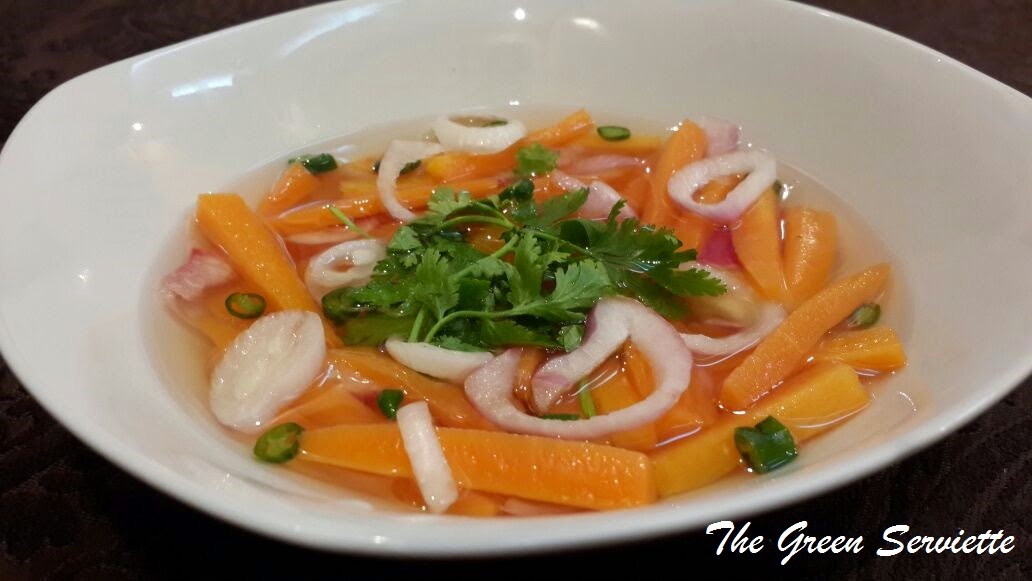
Pickled Carrots - Quick Pickled Carrot Sticks


So there is this old grandma version of pickling fresh veggies like carrots and raw papayas which needs the crispies to be soaked in salt vinegar bath for weeks. No, this is not that version. Here is a toast to instant pickled carrots.

Add or minus the crispies of your choice. You could go for carrots or baby cucumbers or raw papaya or fresh jalapeños or sliced onion. If your taste buds ask for the spice kick, feel free to add in chopped chillies or you could forget about it.

This instant version of pickle takes no time to take in all those flavours because of the one additional step you would do - Blanching. Cooking the veggies in boiling water for 1 minute and immediately cooling it changes the texture of the vegetable. Almost in an instant the carrot would be soft and yet crisp from inside with all the goodness of the flavour. 

Here is what you’ll need:


2-3  carrots
½ cup apple cider vinegar
½ cup water
3/4 tbsp sugar
3/4 tbsp salt
2 green chillies finely chopped
2 cloves garlic

Method:

  • Keep the pickling liquid ready by mixing the vinegar, water, sugar and salt. To the liquid add 2 crushed garlic and finely chopped green chillies.
  • Wash, peel and chop the carrot into juliennes.
  •  In a pot, bring salt water to a boil and blanch the carrot sticks for 1 minute.
  • Immediately drain the boiling water and rinse the carrots with cold water to stop the cooking process.
  • Transfer the carrot to the pickling liquid.
  • Garnish with mint/cilantro/dill leaves for extra flavour.
      
      Also Read: Carrot - The root for health! in the Nutri-knowhow column and Carrot Pudding/ Gajar ka halwa and Carrot Cake in The Kitchen Counter column. 

Post by Zohra Sada

Monday, 1 June 2015

Tawsuli/Sweet rice cake


Sounds weird? I dint name it. Never heard before? You’re not from Bhatkal.

Tawsuli or if I would break it down for you as the sweet rice cake is a special Bhatkali cuisine prepare during weddings with cooked sweetened rice called sakramji.

For those of you searching for gluten free cake or eggless cakes here is something for you. The recipe of this rice cake is pretty straight forward and simple. But needs a lot of stamina as continuous stirring needs to be done non-stop. Let’s go through it step by step.

Heat oil in a big heavy bottom vessel and fry two cardamoms. (I have used a pressure cooker)


Add the washed rice to the ghee. (Do NOT soak the rice)


Roast the rice in the ghee till it turns a deep golden colour. This will take 5-7 minutes.


Add 1 cup of sugar to rice and keep roasting for 1 minute.


To this add 2 ½ cups water and pressure cook till done. Or else cook on open flame till all the rice cooks and moisture evaporates.


Once the rice is cooked add 1 whole finely grated cucumber. No, it’s not an optional step. Somehow the name tawsuli comes from cucumber being present in it.


The next main ingredient going into this will be the coconut milk. I have beaten 2 cups of coconut milk powder with 2 cups of water and added to the cooked rice cucumber mixture. Optionally you can also use thick fresh coconut milk. Add ¼ tsp salt and 1 tbsp rose water.


Now comes the time to test your patience. Cook Cook cook. Stir Stir Stir. Till the milk reduces. Thickens.  And the whole mixture comes together as a lump. It took me around 40 minutes (Phew). Then in goes 1 more cup of sugar. And the moisture increases and you cook it again and reduce it further. At this point, I did add a tad bit of yellow colour. Avoid it if you must.


I also did add a whole egg. This will just give crispier cake. If you want to go eggless, feel free, you won’t notice the difference. The third optional step is a 2-3 tbsp of almond paste/ powder. This is to give the extra rich taste.


Once this is done, the mixture must be really really dry. Transfer the whole mixture into a greased 10” non-stick baking dish. Flatten the cake with the back of a spoon. 


Pop it into a pre-heated oven at 175°C for 25- 30 minutes till the edges go dark brown. If the upper crust hasn't turned golden brown yet, grill it for 5 minutes on high till a crisp golden shell is formed.


Serve it warm.

This recipe serves 15 people and provides approximately 200 calories per serving.

Here is what you’ll need:


1 cup basmati rice / (locally used -“girsal” rice)
2 cups sugar 
1 tbsp ghee
1 cucumber
2 cups coconut milk powder
2 cardamoms
1 tbsp rose water
¼ tsp salt
3 tbsp almond paste/ powder (optional)
1 egg ( optional)
Artificial colouring (optional)

Method:

  1. Roast one cup of washed basmati rice in 1 tbsp of ghee with 2 cardamoms.
  2. Once the rice turns golden brown add 1 cup sugar and roast for 1 minute.
  3. Pressure cook/ Cook on open flame the rice with 2 ½ cups water.
  4. Grate 1 cucumber and add to it.
  5. Mix 2 cups of coconut milk powder with 2 cups water and add to the rice.
  6. Add a tbsp of rose water and a ¼ tsp salt.
  7. Cook till most of the moisture evaporates and add the other cup of sugar.
  8. Cook till further reduced.
  9. Optional to add an egg, almond powder or artificial colour.
  10. Cook till completely dry and transfer into a greased 10” non-stick baking tray.
  11. Bake in pre-heated oven at 175°C for 30 minutes or till golden brown.
  12. Serve warm .

 Recipe by Zohra Sada

Sunday, 10 May 2015

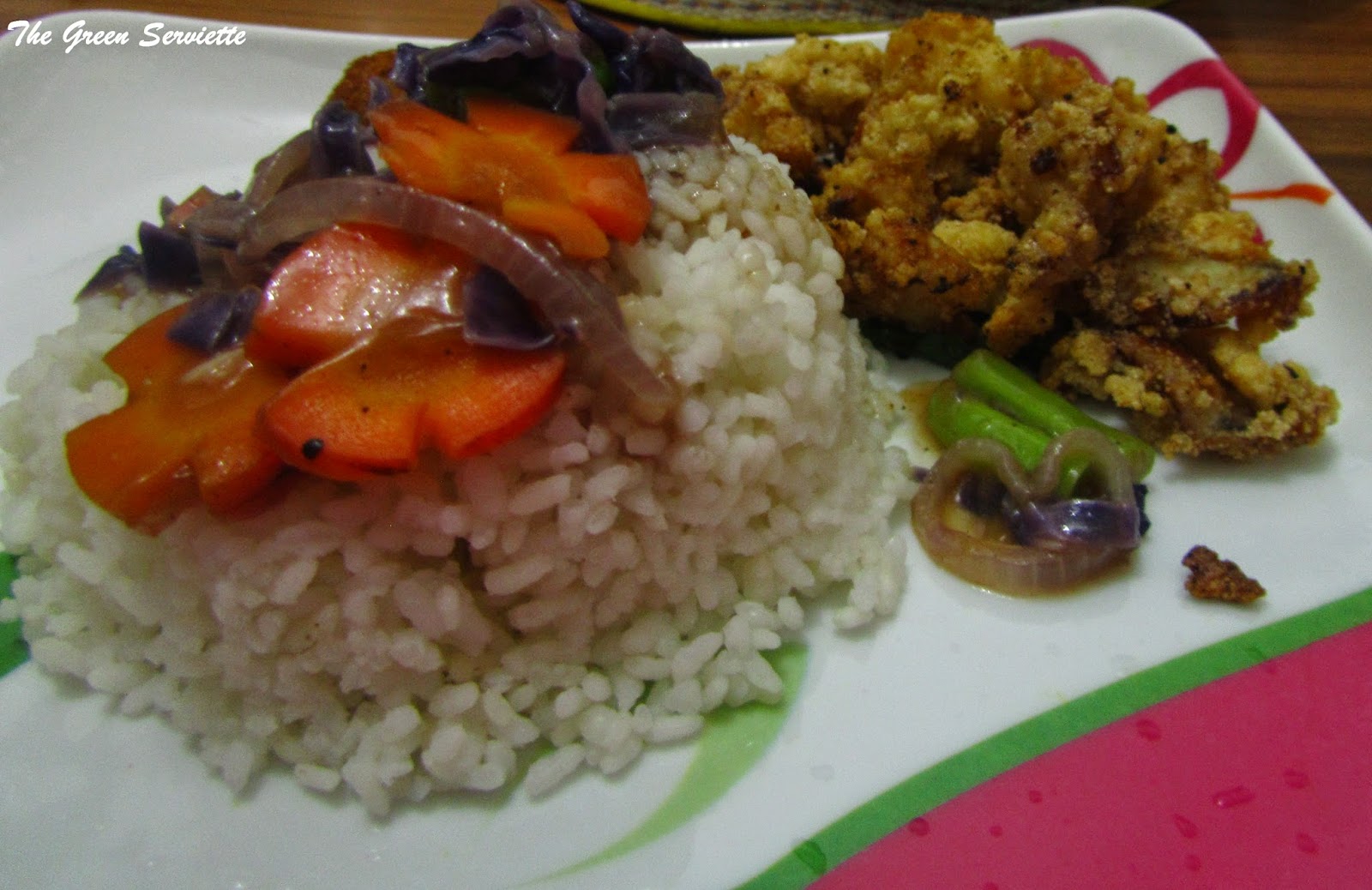
Vegetable Chopsuey Rice


This is an easy quick recipe and at the end of a week all the remaining vegetable at home could be used in the dish. The vegetables can be colorful and cut into fancy shapes if this is being served to kids. Chopsuey is an easy way to add a lot of fiber into a meal. This is a family recipe.

This recipe serves 4 people and one serving provides approximately 222 calories.

Ingredients:


1 Carrot
50 g cabbage
2-3 beans
1 Onion
1 tsp ginger & garlic paste
Salt & pepper as per taste
2 tbsp corn flour
1 tbsp Soya sauce
1 tbsp Butter
1 Cup rice

Method:

  1. Wash and cook the rice. Keep separately.
  2. Whisk together soya sauce, salt and corn flour and add enough water to make up to a cup. Keep aside.
  3. Heat 1 Tbsp butter and add the ginger and garlic paste. Sauté it.
  4. Then add the carrots, cabbage, onions and beans and stir-fry over high heat for a minute.
  5. Add the sauce mixture and cook, stirring continuously. When the mixture thickens adjust salt and pepper. Keep aside.
  6. Transfer rice to a serving dish, pour the vegetables over and serve.
Recipe by Chaya Ranasinghe