Wednesday, 10 June 2015

Red Velvet Cupcakes


The red velvet cupcakes and cakes had been my husband’s request for quite some time and the Valentine’s Day was the best day to try it out. The amount of red food coloring used may be scary for some people but I wanted my cupcakes really RED..!!! The same recipe could be used to bake a red velvet cake.

This recipe makes 18 cupcakes and each cupcake provides approximately 149 Calories.

Ingredients:


250 grams plain flour
2 tablespoons cocoa powder (sifted)
2 teaspoons baking powder
100 grams soft unsalted butter
200 grams caster sugar
1 heaped tablespoon red food colouring
2 teaspoons vanilla extract
2 large eggs
175 ml buttermilk

Method:

  1. Preheat the oven to 170°C and line 3 muffin trays with paper cases.
  2. Mix the flour, cocoa, baking powder and baking powder in a bowl.
  3. In another bowl, cream the butter and sugar, beating well, and when you have a soft, pale mixture beat in the food colouring and the vanilla.
  4. Into this mixture, still beating, add 1 spoonful of the dried ingredients, then 1 egg, followed by some more dried ingredients, then the other egg, followed by the rest of the dried ingredients.
  5. Finally beat in the buttermilk and divide the batter between the 18 cases. 
  6. Bake in the oven for about 55 minutes.
  7. Leave them to cool on a wire rack and don’t ice with the frosting till cupcakes are absolutely cold.
Recipe by Chaya Ranasinghe

Monday, 8 June 2015

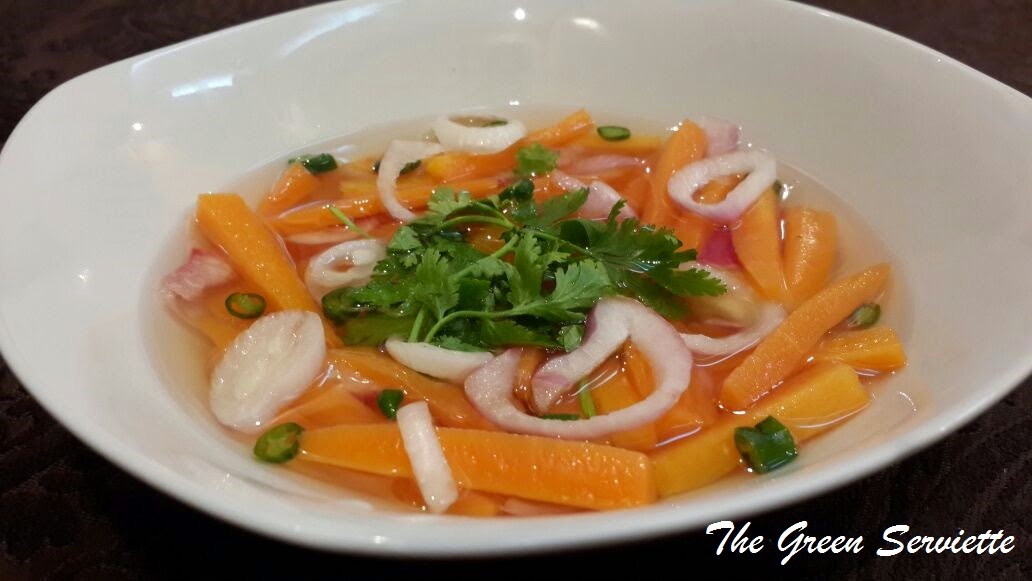
Pickled Carrots - Quick Pickled Carrot Sticks


So there is this old grandma version of pickling fresh veggies like carrots and raw papayas which needs the crispies to be soaked in salt vinegar bath for weeks. No, this is not that version. Here is a toast to instant pickled carrots.

Add or minus the crispies of your choice. You could go for carrots or baby cucumbers or raw papaya or fresh jalapeƱos or sliced onion. If your taste buds ask for the spice kick, feel free to add in chopped chillies or you could forget about it.

This instant version of pickle takes no time to take in all those flavours because of the one additional step you would do - Blanching. Cooking the veggies in boiling water for 1 minute and immediately cooling it changes the texture of the vegetable. Almost in an instant the carrot would be soft and yet crisp from inside with all the goodness of the flavour. 

Here is what you’ll need:


2-3  carrots
½ cup apple cider vinegar
½ cup water
3/4 tbsp sugar
3/4 tbsp salt
2 green chillies finely chopped
2 cloves garlic

Method:

  • Keep the pickling liquid ready by mixing the vinegar, water, sugar and salt. To the liquid add 2 crushed garlic and finely chopped green chillies.
  • Wash, peel and chop the carrot into juliennes.
  •  In a pot, bring salt water to a boil and blanch the carrot sticks for 1 minute.
  • Immediately drain the boiling water and rinse the carrots with cold water to stop the cooking process.
  • Transfer the carrot to the pickling liquid.
  • Garnish with mint/cilantro/dill leaves for extra flavour.
      
      Also Read: Carrot - The root for health! in the Nutri-knowhow column and Carrot Pudding/ Gajar ka halwa and Carrot Cake in The Kitchen Counter column. 

Post by Zohra Sada

Sunday, 7 June 2015

Kidney Stones/ Renal Calculi


Renal Calculi/ Stones can be formed in the kidney, pelvis or ureter, when the concentration of the components in the urine reaches a level in which crystallization is possible. The process of stone formation is also called nephrolithiasis or urolithiasis.

A Kidney stone is a solid mass that consists of a collection of tiny crystals. There can be one or more stones present at the same time in the kidney or in the ureter. They are generally composed of calcium salt, uric acid, cystic or struvite (triple salt of ammonium, magnesium and phosphorus).

Calcium stones are caused due to excess intake of calcium oxalate, hypervitaminosis D, hyperparathyroidism, prolonged bed test, renal tubular acidosis, and idiopathic hypercalciuria.

Struvite stones are caused mostly due to urinary tract infection.

Uric acid stones are caused due to impaired purine metabolism with increased urinary excretion of uric acid.

Cystine stones are caused due to hereditary metabolic defect in renal tubular reabsorption.

Hot climates leading to over concentrated urine, changes in pH of urine also predispose to stone formation. Deficiency of Vitamin B6 and magnesium Also play a role in the causation of these stones.

These stones do not produce any symptoms until they begin to move down the ureter, causing pain. The pain is usually severe and often starts in the flank region, often moves to the groin. The patient experiences blood in the urine, severe pain, weakness and in some cases fever.

The role of the dietary management is to relieve symptoms and prevent further complications.

In acute stage with less than 5mm in diameter, it may pass in the urine by drinking large quantities of fluid especially water and needs no specific treatment. Stones more than 7mm in diameter may require surgical treatment or lithotripsy by which large stones are broken down and excreted in the urine.

It is advisable to have liberal fluid intake, a balanced diet and restrict foods based on the main constituents of the stones.

The diet restrictions for different types of stones are:

Type of stone
Diet restriction
Calcium stones
-          Phosphate
-          Oxalate

Calcium – 400 – 600 mg
Phosphorus – 1000-1200 mg
Struvite stones
Low phosphorus diet
Uric acid
Low purine diet
Cystine
Low methionine diet

Potassium content of food can be reduced by leaching the foods rich in the nutrient by the following methods:
  • Wash, peel and cut vegetables into small pieces. Soak in warm water for 2-3 hours. Discard water. Add large volume of fresh water and cook the vegetables. Discard water.
  • Peel vegetables and cut into small pieces. Bring to boil in a large quantity of water. Discard excess water and cook in a large volume of fresh water. Discard excess water.

Sources of potassium in the diet (Potassium/100 g vegetable) are as follows:

 0 - 100 mg
101 – 200 mg
201 mg and above
Beetroort
Bottlegourd
Broad beans
Cucumber
Field beans
Green mango
Peas
Lettuce
Fenugreek leaves
Bitter gourd
Brinjal
Cauliflower
Cabbage
Carrot
Onion (small)
Radish white
Ladies finger
Pumpkin
Green tomato
Amaranth
Coriander leaves
Drumstick leaves
Spinach
Colocasia
Potato
Sweet potato
Tapioca
Green papaya
Yam

Sources of sodium, calcium, oxalate and Uric acid are as follows:


Post by Faiz Lahori

Monday, 1 June 2015

Tawsuli/Sweet rice cake


Sounds weird? I dint name it. Never heard before? You’re not from Bhatkal.

Tawsuli or if I would break it down for you as the sweet rice cake is a special Bhatkali cuisine prepare during weddings with cooked sweetened rice called sakramji.

For those of you searching for gluten free cake or eggless cakes here is something for you. The recipe of this rice cake is pretty straight forward and simple. But needs a lot of stamina as continuous stirring needs to be done non-stop. Let’s go through it step by step.

Heat oil in a big heavy bottom vessel and fry two cardamoms. (I have used a pressure cooker)


Add the washed rice to the ghee. (Do NOT soak the rice)


Roast the rice in the ghee till it turns a deep golden colour. This will take 5-7 minutes.


Add 1 cup of sugar to rice and keep roasting for 1 minute.


To this add 2 ½ cups water and pressure cook till done. Or else cook on open flame till all the rice cooks and moisture evaporates.


Once the rice is cooked add 1 whole finely grated cucumber. No, it’s not an optional step. Somehow the name tawsuli comes from cucumber being present in it.


The next main ingredient going into this will be the coconut milk. I have beaten 2 cups of coconut milk powder with 2 cups of water and added to the cooked rice cucumber mixture. Optionally you can also use thick fresh coconut milk. Add ¼ tsp salt and 1 tbsp rose water.


Now comes the time to test your patience. Cook Cook cook. Stir Stir Stir. Till the milk reduces. Thickens.  And the whole mixture comes together as a lump. It took me around 40 minutes (Phew). Then in goes 1 more cup of sugar. And the moisture increases and you cook it again and reduce it further. At this point, I did add a tad bit of yellow colour. Avoid it if you must.


I also did add a whole egg. This will just give crispier cake. If you want to go eggless, feel free, you won’t notice the difference. The third optional step is a 2-3 tbsp of almond paste/ powder. This is to give the extra rich taste.


Once this is done, the mixture must be really really dry. Transfer the whole mixture into a greased 10” non-stick baking dish. Flatten the cake with the back of a spoon. 


Pop it into a pre-heated oven at 175°C for 25- 30 minutes till the edges go dark brown. If the upper crust hasn't turned golden brown yet, grill it for 5 minutes on high till a crisp golden shell is formed.


Serve it warm.

This recipe serves 15 people and provides approximately 200 calories per serving.

Here is what you’ll need:


1 cup basmati rice / (locally used -“girsal” rice)
2 cups sugar 
1 tbsp ghee
1 cucumber
2 cups coconut milk powder
2 cardamoms
1 tbsp rose water
¼ tsp salt
3 tbsp almond paste/ powder (optional)
1 egg ( optional)
Artificial colouring (optional)

Method:

  1. Roast one cup of washed basmati rice in 1 tbsp of ghee with 2 cardamoms.
  2. Once the rice turns golden brown add 1 cup sugar and roast for 1 minute.
  3. Pressure cook/ Cook on open flame the rice with 2 ½ cups water.
  4. Grate 1 cucumber and add to it.
  5. Mix 2 cups of coconut milk powder with 2 cups water and add to the rice.
  6. Add a tbsp of rose water and a ¼ tsp salt.
  7. Cook till most of the moisture evaporates and add the other cup of sugar.
  8. Cook till further reduced.
  9. Optional to add an egg, almond powder or artificial colour.
  10. Cook till completely dry and transfer into a greased 10” non-stick baking tray.
  11. Bake in pre-heated oven at 175°C for 30 minutes or till golden brown.
  12. Serve warm .

 Recipe by Zohra Sada